Endodontics

Wednesday, 3 August 2011

Proerties and uses of MTA


Properties

Ø  ph initial 10.2 & rises to 12.5 when set

Ø  Highly alkaline

Ø  Setting Time is 2 hrs 45min

Ø  Compressive strength 40 mpa immediately
   & 70 mpa after 21days

Ø  MTA has calcium oxide which reacts with water to form calcium hydroxide

Ø  This causes formation of calcite crystals & & fibronectin

Ø  These act as initiating step for hard tissue barrier formation

Ø  Fibronectin promotes cellular adhesion & differentiation

Uses

Ø  Repair of perforation

Ø  Root end filling material

Ø  Pulp capping agent

Ø  Apexification

Ø  Apical third filling material

Ø  Obturating material 

Tuesday, 2 August 2011

Advances in material aspect MTA


Advances in material aspect
MTA

Ø  Mineral Trioxide Aggregate
Ø  Developed at Loma Linda University
Ø  By Dr. Mohammed Torabinejad
Ø  Initially developed as perforation repair & root end filling material .
Ø  Now finds wide application in endodontics
Material is
FDA approved & commercially available as
Pro Root MTA


Composition
Ø  Main molecules are calcium & phosphorous ions
Ø  Derived from components
   --tricalcium silicate ,
   --tricalcium aluminate ,
   --tricalcium oxide &
   --silicate oxide
Ø    Bismuth oxide imparts radio-opacity
Portland cements & MTA
Ø  Portland cements contain the same components as MTA except that MTA also contains bismuth oxide for radio-opacity 

Monday, 1 August 2011

APICAL THIRD FILLING , Calcium Hydroxide Apical Filling


APICAL THIRD FILLING
                                                               SimpliFill Obturation


Calcium Hydroxide Apical Filling.

Ø  Mainly used where the apexification is desired
Ø  It is thought to provoke the cementogenesis

Calcium-Phosphate Cement Obturation.

Ø  More recently, Harbert has suggested using tricalcium phosphate as an apical plug,much like dentin shavings and calcium hydroxide have been used

Ø  In testing the sealing ability of CPC when used as a root canal sealer-filler, the Paffenbarger group reported that in most of the specimens there was “no dye penetration into the filler-canal wall interface”

Ø  Two calcium phosphate compounds, one acidic and one basic, are unique in that when mixed with water they set into a hardened mass”—hydroxyapatite—the principal mineral in teeth and bones

Ø  Another possibility of using hydroxyapatite relates to the laser. A cross-linked collagen-hydroxyapatite mixture has been placed in the root canal and “melted” to place with a laser beam through a fiber optic.

Ø  Another possibility of using hydroxyapatite relates to the laser. A cross-linked collagen-hydroxyapatite mixture has been placed in the root canal and “melted” to place with a laser beam through a fiber optic.

Sunday, 31 July 2011

Thermoplasticized Injectable Gutta-percha Obturation


Thermoplasticized Injectable Gutta-percha Obturation


SOLID-CORE CARRIER: MANUAL INSERTION THERMAFIL


Saturday, 30 July 2011

Advances in Obturation - Thermomechanical Solid-Core Gutta-percha Obturation


Advances in Obturation

Thermomechanical Solid-Core Gutta-percha Obturation


Ø  This system consists of titanium core devices that come in ISO sizes 15 to 60, resemble latch-type endodontic drills, coated with alpha-phase gutta-percha
Ø  These devices are fitted to the prepared root canal and then, following the sealer, are spun in the canal with a regular low-speed, latch-type handpiece.

Ø  Friction heat plasticizes the gutta-percha and it is compacted to place by the design of the Quick-Fill core.
-

Friday, 29 July 2011

Newer irrigating solutions And lasers


Newer irrigating solutions

Ø  Salvizol
Ø  Tublicid
Ø  BDA ( Bis-dequalinium acetate) Solvidont
Ø  Ozonized water
Ø  Endo Dilator N 
Ø  Electro chemically activated water
Ø  MTAD

Lasers are mainly used in Preparatory Phase of Endodontics for disinfecting the root canal and biomechanical preparation

Thursday, 28 July 2011

Lightspeed and quantec files


LIGHTSPEED FILE


Ø  Resembles a Gates-Glidden drill  
Ø  Used in apical curvatures where rotary instruments may be in jeopardy.
Ø  Speed: 1,300 to 2,000 rpm 
Ø  The instruments come in ISO sizes beginning with No. 20  to 140.
Ø  Advantages: the ability to finish the apical-third preparation 

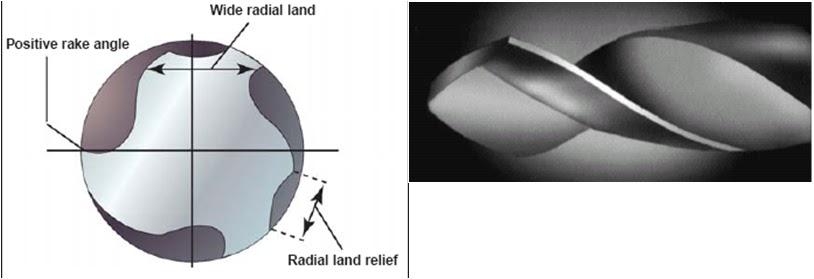
QUANTEC FILES


          Although called a “file,” is more like a reamer—a drill.
          Produced in three different tapers—0.02, 0.04, and 0.06.
          Quantec flare series — 0.08, 0.10,& 0.12 taper for coronal 1/3rd.
          The radial lands of the Quantec are slightly relieved to reduce frictional contact with the canal wall, and the helix angle is configured to efficiently remove debris.